
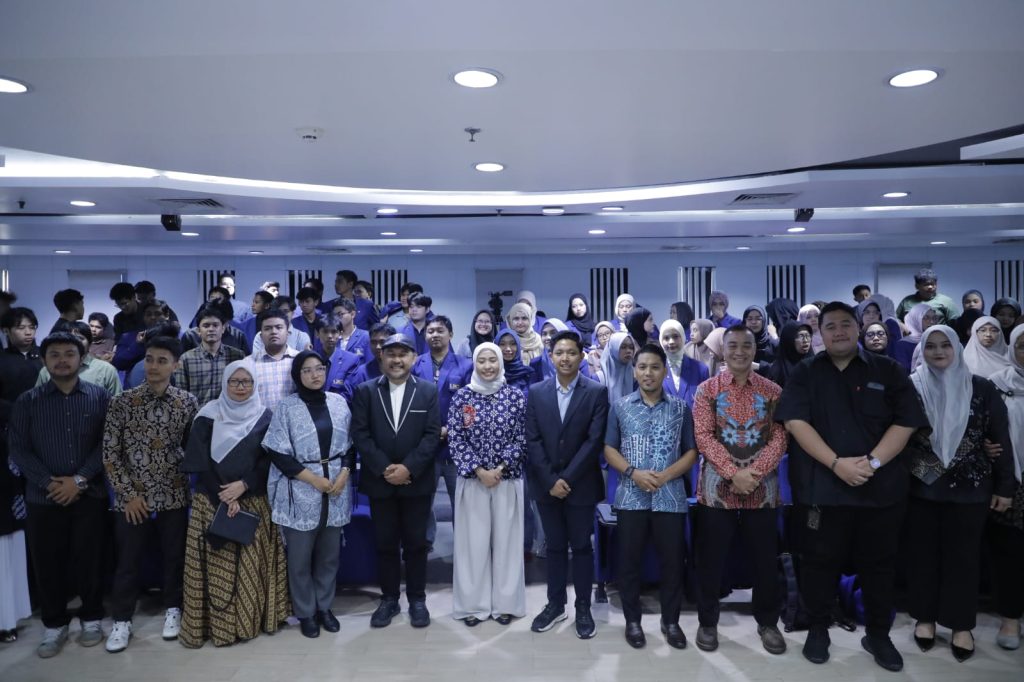
JAKARTA, November 26, 2026 – Universitas Ary Ginanjar (UAG) hosted the International Symposium 2026 under the theme “Reimagining Global Business: Entrepreneurship, Human Capital, and Sustainable Growth” on Thursday, November 26, 2026, at the 18th-floor Auditorium of Menara 165, Jakarta. The event was conducted in a hybrid format, bringing together participants both in person and online through Zoom.
The symposium was organized through a strategic collaboration between Universitas Ary Ginanjar (UAG), Universiti Kebangsaan Malaysia (UKM), the Islamic World Development Network (IWDN), and Universitas Teknologi Nusantara (UTN). It provided an international platform for academics, business practitioners, and institutional stakeholders to exchange perspectives on the future of global business, with particular attention to entrepreneurship, human capital development, ethical leadership, innovation, and sustainable economic growth.
The event was attended by several distinguished figures, including Diah Utami Aryanti, S.S., M.Ed., M.M., Rector of Universitas Ary Ginanjar; Faqih Fadilah Muttaqin, S.Hum., M.A., President of IWDN; Muhammad Zaini, M.B.A., Dean of the Faculty of Social Sciences and Economics at Universitas Teknologi Nusantara; Andi Purnomo, S.Kom., M.Kom., Vice Rector I for Academic Affairs, Student Affairs, and Cooperation at UAG; and Junita Dwi Purwandari, Ph.D., Head of the Institute for Research and Community Service (LPPM) at UAG. The founder of Universitas Ary Ginanjar, Prof. Dr. Ary Ginanjar Agustian, also delivered his remarks through a video address.
In his address, Prof. Ary Ginanjar Agustian emphasized that entrepreneurship should not be measured solely by financial profit. Rather, businesses should create value, address societal challenges, and generate meaningful benefits for communities. He highlighted that technological advancement must be accompanied by human qualities, particularly character, integrity, and collaboration. While technology accelerates progress, it is human beings who ultimately determine the direction and purpose of that progress.
Echoing this perspective, UAG Rector Diah Utami Aryanti highlighted the importance of integrating intellectual, emotional, and spiritual intelligence through the ESQ approach in preparing future leaders. She outlined three essential profiles of future business leaders: entrepreneurs, who create business opportunities; intrapreneurs, who drive innovation within organizations; and business successors, who preserve organizational and family business legacies while embracing innovation. She stressed that professional competence must go hand in hand with strong character to ensure organizational sustainability across generations.
Meanwhile, IWDN President Faqih Fadilah Muttaqin addressed the significant yet underutilized economic potential of the Muslim world. Comprising 57 countries with a population of approximately 2.2 billion people, the Organization of Islamic Cooperation (OIC) represents a substantial opportunity for strengthening international economic cooperation. However, intra-OIC trade remains below 20 percent, indicating that the economic potential of Muslim-majority countries has yet to be fully translated into stronger trade connectivity and collaboration.
Faqih emphasized Indonesia’s strategic position in advancing this agenda. As the country with the world’s largest Muslim population, Indonesia has considerable potential to contribute to human capital development, entrepreneurship, and cross-border business partnerships among Islamic countries. In this regard, international academic networks such as IWDN can play an important role in connecting institutional capacities, knowledge resources, and business opportunities across the Muslim world.
One of the key highlights of the symposium was the signing of Memoranda of Understanding (MoUs), Memoranda of Agreement (MoAs), and Implementation Arrangements (IAs) between Universitas Ary Ginanjar and three partner institutions: the Islamic World Development Network (IWDN), Universiti Kebangsaan Malaysia (UKM), and Universitas Teknologi Nusantara (UTN).
The agreements establish a framework for cooperation in joint research, international academic forums, faculty and student exchanges, visiting professor programs, and cross-border leadership development. These partnerships are expected to extend beyond formal institutional commitments and translate into concrete collaborative initiatives that benefit universities, academics, students, and wider communities.
The symposium also featured a panel discussion with three distinguished speakers, moderated by Aura Ashdalare, Deputy Executive Director of the Center for Research, Technology, and Innovation at IWDN.
The first speaker, Dr. Roslan Jaafar, Senior Lecturer at the UKM Graduate School of Business, discussed Environmental, Social, and Governance (ESG) practices and corporate risk management. He explained that ESG implementation does not eliminate business risks but enables companies to identify, assess, and manage risks more responsibly. ESG also serves as an important mechanism for improving transparency and reducing information asymmetry between management and investors. Nevertheless, he highlighted the challenges faced by micro, small, and medium-sized enterprises (MSMEs), particularly the financial burden associated with green transitions and ESG audits. He therefore called for proportionate government policies that recognize the different capacities of large corporations and smaller businesses.
The second speaker, Dr. Ismail Suardi Wekke, a member of the IWDN Scientific Committee, explored human capital development through collaboration and innovation rooted in local values. He emphasized that competitiveness in the modern era cannot rely solely on individual capabilities but must be supported by a strong culture of collective action and cooperation. Drawing lessons from South Korea’s Saemaul Undong movement, he illustrated how collective values can become a foundation for national development and industrial transformation. He further stressed the importance of cultivating collaboration from an early age and promoting value-based businesses that prioritize ethical practices and public welfare.
The third speaker, Abdul Haris Mukhtar, S.Ag., M.M., Head of the Character Department and Business Management lecturer at UAG, discussed strategies for achieving sustainable organizational growth. He highlighted that a company’s size, financial resources, and assets do not automatically guarantee its long-term survival. Through the inside-out approach, he argued that sustainable business growth must begin with core values, organizational purpose, and leadership integrity. Even the most sophisticated organizational systems and strategies will remain fragile without a strong ethical and moral foundation.
Through the International Symposium 2026, UAG, UKM, IWDN, and UTN reaffirmed their commitment to strengthening international collaboration at the intersection of education, research, entrepreneurship, and sustainable development. The symposium served as an important platform for advancing academic partnerships and encouraging institutions to respond collectively to the evolving challenges of the global economy.
For IWDN, this collaboration represents an opportunity to expand its international network by connecting academics, educational institutions, and stakeholders across countries, particularly in strengthening the capacity of the Muslim world. Moving forward, these partnerships are expected to foster innovation, facilitate knowledge exchange, and support economic development that is not only competitive but also ethical, inclusive, and sustainable.
