
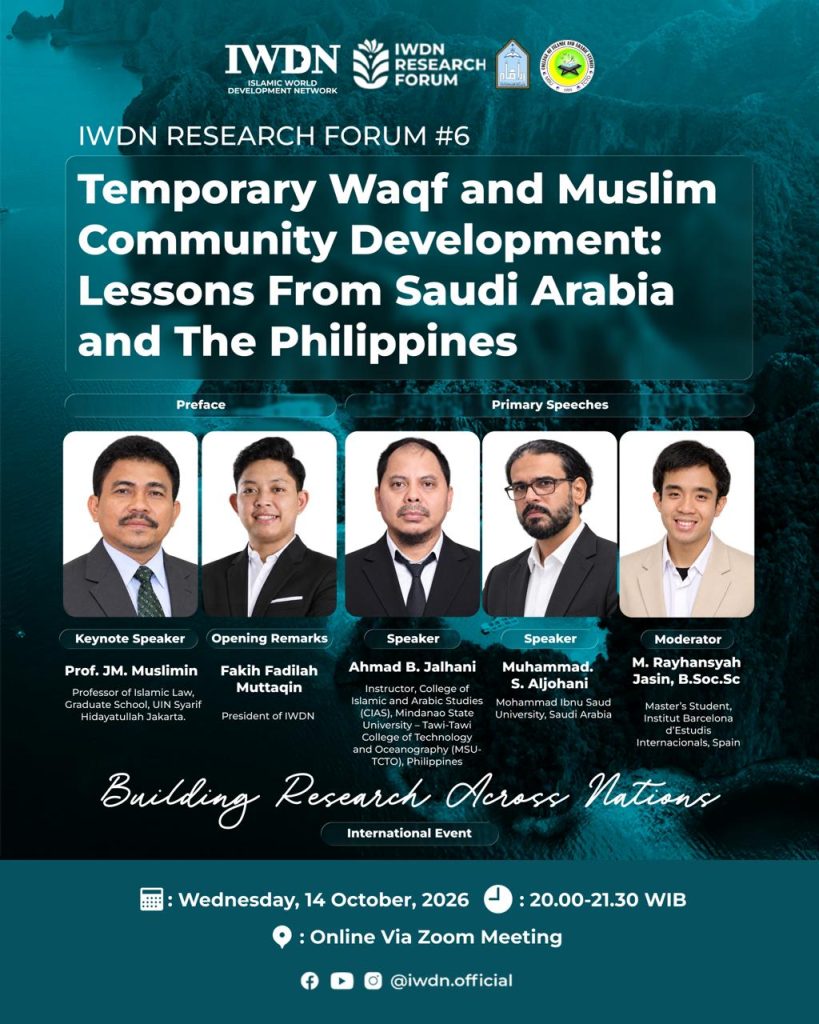
Jakarta, 14 October 2026 — The Islamic World Development Network (IWDN) held its sixth Research Forum under the theme “Temporary Waqf and Muslim Community Development: Lessons from Saudi Arabia and the Philippines” on Wednesday, 14 October 2026, via Zoom Meeting.
The forum brought together academics and scholars from Indonesia, the Philippines, and Saudi Arabia to examine waqf mu’aqqat (temporary waqf) from classical and contemporary Islamic perspectives, with particular attention to its potential applications in education, economic empowerment, and sustainable community development. Waqf has historically played a significant role in Islamic civilization, supporting religious institutions, educational facilities, healthcare, and social welfare. In the modern era, its development has expanded to include cash waqf, productive waqf, digital waqf platforms, and innovative financing models that seek to maximize social impact. Against this background, the forum explored how contemporary waqf models can respond to the evolving needs of Muslim communities while remaining grounded in Islamic jurisprudence, sound governance, and applicable legal frameworks.
Bridging Classical Islamic Jurisprudence and Modern Waqf Practices
Prof. JM. Muslimin, Professor of Islamic Law at the Graduate School of UIN Syarif Hidayatullah Jakarta, contributed an academic perspective on the jurisprudential foundations of waqf and the importance of examining contemporary developments through the framework of Islamic law. One of the key questions surrounding temporary waqf concerns how emerging models can address modern socioeconomic needs while respecting the principles and legal requirements governing waqf. Proposed quotation for speaker confirmation: “The development of waqf in the modern era requires a meaningful dialogue between classical Islamic jurisprudence and contemporary societal needs. Every innovation, including temporary waqf, must be carefully examined in light of Islamic legal principles, the nature of the endowed assets, and the public benefit it seeks to achieve.”
IWDN Calls for Waqf Innovation to Support Community Development
Fakih Fadilah Muttaqin, President of IWDN, emphasized the importance of positioning waqf within a broader framework of international cooperation, social innovation, and community empowerment. According to this perspective, waqf should not be viewed solely as a charitable institution. With appropriate governance and professional management, it can also contribute to educational access, economic participation, institutional development, and long-term community resilience. Proposed quotation for speaker confirmation:
“We need to view waqf not only as a legacy of Islamic philanthropy, but also as a potential instrument for development. Through responsible innovation and cross-border collaboration, waqf can help expand educational opportunities, strengthen economic empowerment, and improve the well-being of Muslim communities.” Fakih also highlighted the importance of connecting academic research with practical initiatives, encouraging universities, Islamic institutions, and development networks to collaborate in identifying models that can be adapted to different national and local contexts.
The Philippines: Connecting Waqf with Local Community Needs
Ahmad B. Jalhani, an instructor at the College of Islamic and Arabic Studies (CIAS), Mindanao State University–Tawi-Tawi College of Technology and Oceanography (MSU-TCTO), Philippines, brought a perspective relevant to the development of Muslim communities in the Philippine context. The discussion highlighted the potential for waqf to support education, local economic initiatives, social infrastructure, and community-based development. Realizing this potential requires an understanding of local needs, transparent management, and active participation from the communities concerned. Proposed quotation for speaker confirmation:
“Waqf development should begin with the actual needs of the community. It can become a valuable instrument for expanding educational opportunities, supporting local economic activities, and strengthening social infrastructure when it is designed around local conditions and managed transparently.” The Philippine perspective also provides opportunities to explore cooperation among educational institutions, community organizations, and Islamic institutions in developing more effective approaches to waqf management.
Saudi Arabia and the Future of Innovative Waqf
Muhammad S. A. Johani, representing Imam Muhammad Ibn Saud University in Saudi Arabia, contributed an international perspective on the development of waqf and its potential role in contemporary Muslim societies. The discussion underscored the importance of institutional capacity, productive asset management, and innovative financing approaches in ensuring that waqf generates sustainable social benefits. Proposed quotation for speaker confirmation: “The future of waqf depends not only on the value of the assets accumulated, but also on the quality of their management and the impact they generate. Innovation should focus on measurable public benefit while maintaining Islamic principles and institutional accountability.” Comparing perspectives from Saudi Arabia and the Philippines provides an opportunity to examine different institutional experiences and identify approaches that may be adapted to the needs of Muslim communities in different settings.
The forum highlighted the evolving role of waqf in building a modern Islamic social finance ecosystem, emphasizing innovations in cash and digital waqf, productive endowments, temporary waqf (waqf mu’aqqat), and the integration of waqf with education, healthcare, and other Islamic financial instruments. Discussions underscored the importance of strong governance, professional waqf management, Sharia compliance, transparency, asset protection, and measurable social impact in ensuring that waqf delivers sustainable benefits to communities. Moderated by M. Rayhansyah Jasin, B.Sc., a master’s student at the Institut Barcelona d’Estudis Internationals, Spain, the forum reaffirmed the Islamic World Development Network’s (IWDN) commitment to strengthening cross-national academic collaboration by connecting research, policy dialogue, and institutional partnerships. Through its Research Forum series, IWDN continues to promote knowledge exchange and innovative approaches to waqf and Islamic social finance, contributing to inclusive, resilient, and sustainable development across Muslim societies. Building Research Across Nations.
About IWDN
The Islamic World Development Network (IWDN) is an international collaboration network focused on the development of the Islamic world through research, education, international cooperation, and community development initiatives. Through academic forums and cross-border partnerships, IWDN promotes knowledge exchange and collaborative solutions to contemporary development challenges.
Media Contact:
Islamic World Development Network (IWDN)
Media and Communications Division
WhatsApp us