
China’s development experience offers an important proposition for the Global South: poverty reduction and structural economic transformation do not necessarily have to originate from urban centers. Rural areas can become critical foundations of economic transformation when local productive capacity, human capital, and endogenous economic resources are effectively connected to wider markets and development networks.
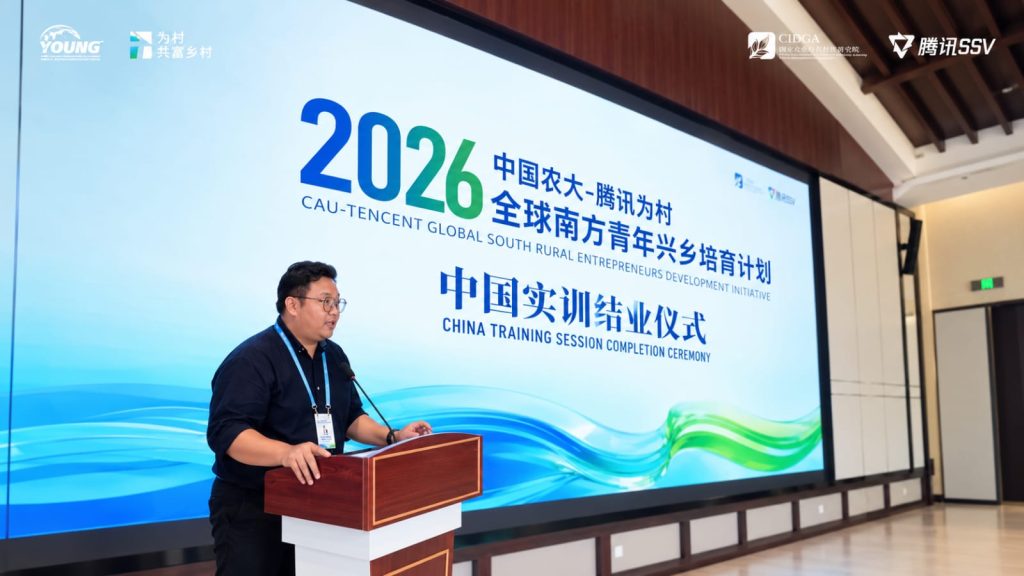
This perspective became particularly relevant to me after spending 10 days participating in the China Agricultural University–Tencent Global South Rural Entrepreneurs Development Initiative 2026 in Beijing and Yunnan. The experience provided an opportunity to observe how rural transformation has been integrated into China’s broader development trajectory and to reflect on a question increasingly relevant for Indonesia and other developing countries in Southeast Asia: how can rural communities move beyond being recipients of development interventions and become active agents of economic transformation?
China’s contemporary economic position is significant when viewed against its historical trajectory. In 1978, approximately 250 million people in China were living in poverty, equivalent to around 30.7 percent of the population. By 2020, China stated that it had eliminated absolute poverty according to its national poverty standard. Between 2012 and 2020, approximately 99 million rural residents were lifted out of poverty, while 832 poor counties and 128,000 poor villages were removed from the poverty lists.
Yet poverty reduction represents only one dimension of China’s development experience. Since 2022, China has entered a broader phase of development aimed at building a modern socialist country, with development objectives toward 2035 that include reducing urban-rural disparities, improving public services, expanding the middle-income population, and advancing common prosperity.
This trajectory suggests that rural development should not be understood merely as poverty alleviation. It is also about developing productive capabilities that enable rural communities to participate in long-term economic transformation. One important lesson from China is the role of rural reform as an early entry point for broader structural transformation. Improvements in agricultural productivity generated economic surpluses and created opportunities for capital and labor to move into manufacturing and other sectors.
The experience of Xiaogang Village in Anhui Province illustrates this process. In 1978, 18 farmers agreed to change the organization of agricultural production. In 1979, the village produced approximately 66 tons of grain, equivalent to its total production during the preceding five years. The experience demonstrated how institutional and managerial changes at the grassroots level could unlock previously constrained productive capacity.
However, productivity alone does not automatically create sustainable rural development. Economic potential requires human capital capable of identifying opportunities, organizing resources, managing enterprises, accessing markets, and building networks. This is where the concept of the Rural CEO becomes particularly relevant.
The Rural CEO can be understood as a human-capital and entrepreneurial approach that brings managerial capacity, market orientation, professional knowledge, and networks into rural economies. Rather than simply managing a rural business, a Rural CEO can function as an intermediary connecting local resources and community-based economic activities with markets, investment, technology, knowledge, and wider business networks.
This perspective also requires a broader understanding of success. A Rural CEO should not be defined solely by the ability to maximize profit from rural resources. Profitability remains essential for enterprise sustainability, but rural development requires attention to inclusive value creation: increasing household incomes, creating employment, improving market access, utilizing village assets productively, and retaining greater economic value within rural communities. Profit, therefore, becomes a means of generating sustainable prosperity rather than an end in itself.
This distinction is particularly relevant for Indonesia. Indonesian villages possess substantial potential in agriculture, plantations, fisheries, tourism, handicrafts, culinary industries, and the creative economy. The challenge is often not the absence of resources, but the limited capacity to transform those resources into higher-value economic activities. A village may have valuable commodities but limited market access; tourism potential but weak destination management; talented young people but limited entrepreneurial ecosystems; or productive assets without the managerial capacity to develop them sustainably.
The Rural CEO approach addresses this gap between potential and value creation.
Nevertheless, Indonesia should not attempt to replicate China’s development trajectory mechanically. The two countries differ in institutional arrangements, demographic structures, economic systems, geography, and rural characteristics. The more relevant question is which principles can be adapted to Indonesia’s own context. One such principle is that rural development should move beyond program delivery toward building local capacity for continuous value creation. Infrastructure, capital, training, and assistance can initiate development, but their long-term impact depends on whether communities can transform these resources into productive and sustainable economic activities.
The Rural CEO should therefore be understood not merely as a job title, but as an institutional and human-capital approach to rural economic transformation. Its purpose is to connect local potential with professional knowledge, technology, capital, markets, and networks while ensuring that economic value creation contributes to community welfare. For Indonesia and other developing countries in Southeast Asia, the broader lesson from China is clear: rural communities can become active participants in structural transformation when productivity, institutions, human capital, entrepreneurship, and market connectivity develop together. The future of rural development may depend not only on how much development is brought to villages, but on how much capacity villages possess to create and sustain their own prosperity.
WhatsApp us