
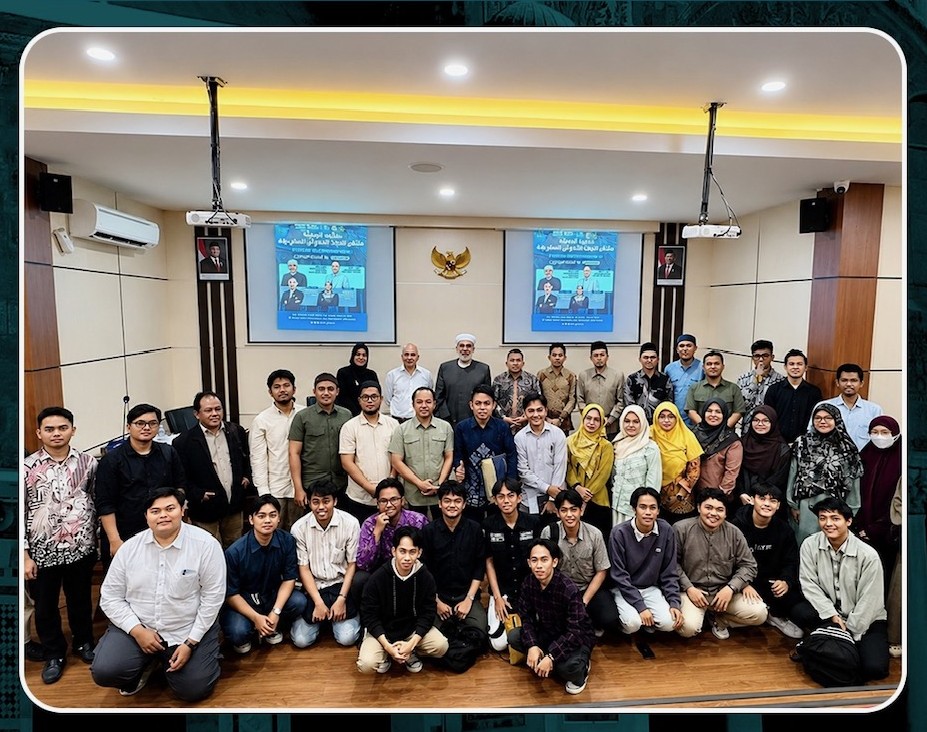
Jakarta, Indonesia — The Islamic World Development Network (IWDN) convened the IWDN Research Forum #5 on 25 June 2026 at the Theater Hall of the Graduate School, UIN Syarif Hidayatullah Jakarta. Under the theme “Islamic Wasathiyah under the Syrian Government,” the international academic forum brought together scholars to examine Islamic moderation, modernity, and the evolving political and intellectual landscape of Syria.
The forum featured Prof. Dr. Mohamad Wahbi Sulaiman, Rector of Bilad al-Sham University and Advisor to the President of Syria, alongside Dr. Mohammad Aboomar, an academic affiliated with Dublin City University, Ireland. The discussion was moderated by Madihah Tirmidzi, a doctoral student at the Graduate School of UIN Syarif Hidayatullah Jakarta.
Opening the forum, Fakih Fadillah Muttaqin, President of IWDN, highlighted the importance of strengthening international academic dialogue on contemporary developments across the Islamic world. He emphasised that transformations in Muslim societies should not be viewed solely through the lenses of political conflict and geopolitical competition, but also through the evolution of ideas, institutions, and intellectual traditions.
“The Islamic world is undergoing significant transformation. Academic institutions and research networks have an important responsibility to create spaces where these changes can be discussed critically, openly, and through international collaboration,” said Fakih.
The forum forms part of IWDN’s broader commitment to “Bridging Research Across Nations” by connecting scholars, universities, and research communities from different regions of the world.
In his presentation, Prof. Dr. Mohamad Wahbi Sulaiman discussed the role of Islamic wasathiyah in the contemporary Syrian context. His perspective highlighted the importance of moderation, social balance, and constructive dialogue in responding to the complex realities facing Syrian society.
The discussion placed particular attention on the potential role of Islamic values in strengthening social cohesion and supporting the reconstruction of society after prolonged periods of instability. Within this context, wasathiyah should extend beyond religious rhetoric and contribute to the development of a more balanced and inclusive social order.
The Syrian experience also raises broader questions about the relationship between Islamic institutions, governance, and national development. As Syria navigates a changing political landscape, the interpretation and implementation of Islamic principles may become an important element in shaping its future social and institutional direction.
Dr. Mohammad Aboomar presented a critical academic perspective through his presentation titled “Wasathiyah: A Modernist Interpretation of Islam?”
He examined wasathiyah through two competing perspectives: as a modernist interpretation of Islam capable of engaging with contemporary social realities, and as a rhetorical or discursive device that may be employed for political purposes.
Drawing on a framework that distinguishes between scripture, historical practice, and individual belief, Aboomar argued that discussions on Islamic moderation should recognise the complexity of Islamic interpretation. Scripture provides a common referential foundation for Muslims, while historical practices and individual beliefs remain shaped by interpretation and diverse social experiences.
A central issue raised during the presentation was the meaning of modernity itself. Rather than treating modernity as a single universal experience, Aboomar highlighted the concept of multiple modernities, in which societies experience and interpret modern conditions according to their historical, cultural, economic, and political contexts. The Arab experience during the Nahdah, Indonesia’s post-independence trajectory, and contemporary Syria therefore represent distinct encounters with modernity.
The forum also explored two major orientations of wasathiyah.
The first is an outward-looking orientation, which presents Islam as a moderate tradition in its relationship with other religions, ideologies, and social systems. The second is an inward-looking orientation, which encourages Muslims to develop moderate interpretations of Islam in response to changing realities.
This distinction has become increasingly relevant in contemporary debates on Islam. The presentation noted that discussions of wasathiyah after the September 11 attacks increasingly turned inward, placing greater emphasis on how Muslim communities interpret their own religious traditions.
The discussion therefore challenged participants to move beyond simplistic definitions of moderation. Wasathiyah is not merely about occupying a middle position between two extremes. It also involves continuous intellectual engagement between Islamic scripture, historical experience, and contemporary social realities.
One of the central questions emerging from the forum was: How will Syria’s evolving political order negotiate the relationship between Islam and modernity?
The question reflects a broader challenge facing many Muslim societies. Modernity generates complex social, political, and intellectual questions not only for Islam but also for religious and national traditions across the world.
For Syria, this debate is particularly significant as the country enters a new phase of political and social transformation. The way Islamic values, religious institutions, and concepts such as wasathiyah are interpreted may influence the country’s emerging national discourse.
Through IWDN Research Forum #5, scholars and participants were encouraged to examine these developments from a research-based and comparative perspective rather than through political narratives alone.
IWDN Research Forum is an international academic platform initiated by the Islamic World Development Network to strengthen research collaboration and intellectual exchange across countries.
Through the forum series, IWDN seeks to connect scholars, universities, policymakers, and emerging researchers in discussing strategic issues affecting the Islamic world and the Global South.
The fifth edition of the forum reaffirmed IWDN’s commitment to creating an international knowledge network where contemporary developments in Muslim societies can be examined critically, academically, and collaboratively.
IWDN Research Forum — Bridging Research Across Nations.
WhatsApp us